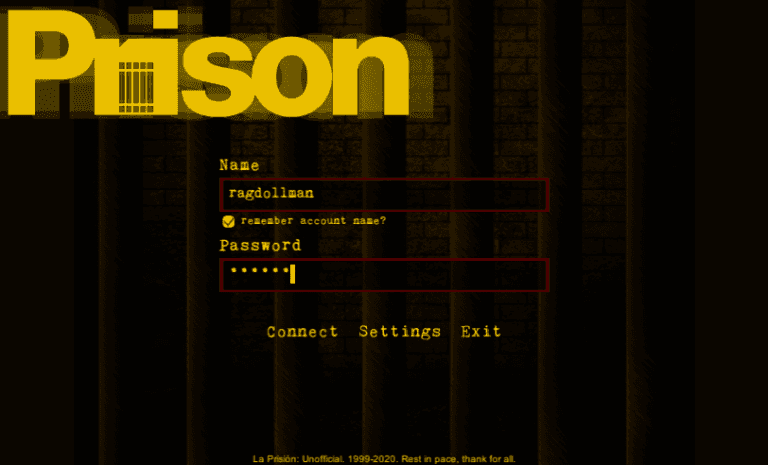

Hello, everyone! Welcome to the official blog of the Revive La Prisión project.

As many of you know, in 2018, the game’s servers shut down for good, prompting a group of former players to form a community in the hope of playing again someday.
That day is getting closer and closer.
As I write this, there are just two of us programmers, so the workload is massive. But that doesn’t bother us—we’re happy to dedicate the time a project like this requires, which I estimate will take at least a year. Hopefully, in 2021, we’ll be able to launch an open beta.
Technology Used
There have been many debates about which technologies to use in development, but in the end, the winners were the following:
- Smartfoxserver 2X: Main server
- Unity 2019.X: Main engine
What does this mean for the game’s future? On one hand, neither of these technologies is open-source or free, though both offer a free version with limited features. It is within these limitations that the game will operate.
One of those limits, for example, is the number of concurrent users who can connect to La Prisión, which will be around 100 users per prison.
The main reason for using these two technologies is time-related. Both Unity and Smartfoxserver save, if not hundreds, then thousands of hours in development. The second reason is that both tools offer the option to upgrade to a paid plan, unlocking all those imposed limits, and the third is that these are the tools that, as of today, 2020, most developers are familiar with, which will allow us to expand our technical staff in the future.
The “essence” of a 1999 game
For me, this is one of the main reasons I’m involved in this development. The fact is that the games that exist today have little or nothing to do with what their ancestral precursors were like.
To preserve that essence, we’ve made some decisions regarding both mechanics and graphics.
Mechanically, it will be quite similar to the original game, meaning: click-and-point movement, static cameras, turn-based 3D combat, and a strong focus on chat.
Graphically, it’s quite difficult to achieve something similar, especially since there are only two programmers handling day-to-day development. So if you’re someone eager to collaborate and have expertise in the audiovisual field, please contact us on Telegram (@jcastro3d, @Jontxus, @JOTACorso).
We’ve developed a tool to simulate pre-rendered backgrounds that captures the essence of that era while adding certain graphical enhancements that fit the style perfectly.
Here’s how it works: We load a pre-rendered background image, then overlay a simplified version of the level on top of it and add an invisible shader.
And the key to it all lies in that shader. Despite being invisible, it will continue to hide the geometry of other 3D elements behind it, while also being able to receive shadow projections from the rest of the elements.
This allows for richer visual behavior closer to what modern games can offer us today, while maintaining that essence of a grainy, old-school pre-rendered image that is so difficult to achieve with real-time 3D.
The video below was the first example of this technology when we used it, and it was a video that circulated on the official Telegram channel for a while. As you can imagine, it’s not an environment that will be used in the game, nor is the character.
Rule System
Every role-playing game needs a ruleset that underpins character progression, combat, and the environment. Unfortunately, La Prisión used its own proprietary ruleset, and we know almost nothing about how it worked internally.
Although we have information such as how many points a character had at the start of their creation, or their total hit points based on their constitution, we are missing a great deal of data to be able to program a similar rule system.
This has forced us to look for an alternative. We are currently debating which system to use, so now would be a good time to join the discussion in the comments and share your opinion on the matter.
We are currently considering the D&D ruleset, specifically the OGL version—the same one used by Pathfinder—which is open-source. This would allow us to use it without legal issues, plus the peace of mind that comes with a system backed by over 20 years of testing.
What do you think about this? Is there a ruleset you know of that you think would be a perfect fit for La Prisión?
Persistence System
There are many types of MMOs, with many different mechanics, but they all share the concept of persistence. Our small team already has the foundation in place to enable persistence for accounts and characters (though not yet for items or other elements).
Although it may not seem like much, these are the first steps upon which the rest of the systems will be built.
- Account registration in our database
- Encryption system for user credentials.
- Character creation, both in terms of stats and graphics.
- Deleting a character (from the owner’s account)
Here’s a video showing the game’s current status. Keep in mind that this is a prototype—we’re focusing on functionality and putting the art on the back burner for now. Typically, video game companies don’t show this kind of thing to the public yet, as it’s still too early in the process. I hope you find it interesting anyway.
Greetings to all!
The new team at La Prisión
COMMENTS
3 comments
You need to be signed in to comment.
Sign inVamos !!
Adelante, gran trabajo!
Qué ilusión este proyecto. ¡Gran trabajo!